
Research study ·
Maintenance Audit Trails, Team Structure, and Owner Retention in Multi-Unit Operations
How fragmented maintenance communication creates litigation-discovery risk and owner churn, and how mid-to-large property groups structure pod, departmental, and hybrid handoffs.
Methodology
Research window 2026-11-27 to 2026-11-27
- This study synthesizes verbatim operator transcripts from The Multifamily Innovation Podcast, The Property Management Show (Fourandhalf), Peter Lohmann’s Newsletter, and Multifamily Collective read on 2026-11-27.
- Survey percentages and operational counts are quoted only where explicitly reported in the cited publication or transcript.
- Organizational structures (portfolio, departmental, and pod or hybrid models) are compared using documented handoff mechanics described by active third-party operators.
Findings
Rent ledgers are centralized, while maintenance communication still fractures across phones
Operators interviewed on The Multifamily Innovation Podcast point to an asymmetry inside most property systems: pulling a unit’s full rent-payment history in Yardi or ResMan takes seconds, whereas reconstructing every team and vendor communication about that same unit is often impossible. [The Multifamily Innovation Podcast (Buzzsprout Transcript), read 2026-11-27]
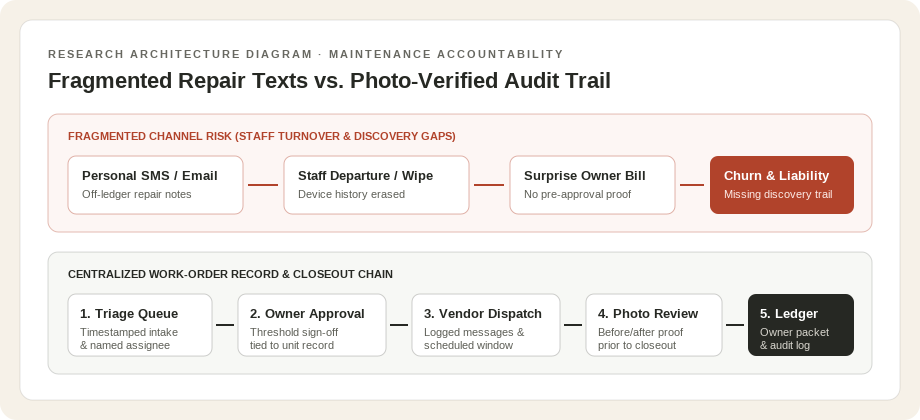
One operator recounted losing an entire building to a burst sprinkler system and receiving a discovery request eight months later demanding every message sent during the three weeks after the break—only to discover that a departed staff member’s phone had been wiped, erasing the text history. [The Multifamily Innovation Podcast (Buzzsprout Transcript), read 2026-11-27]
Disjointed communication spans maintenance technicians, vendors, onsite managers, and ownership groups, creating blind spots whenever personnel turn over. [The Multifamily Innovation Podcast (Buzzsprout Transcript), read 2026-11-27]
Unexplained maintenance expenses directly drive client owner churn
Citing the 2026 PM Trends Report (a Harris Poll survey of five hundred owners holding one to ten units), Peter Lohmann reported that 31% of small landlords would consider selling their property after a single surprise repair under $15,000—effectively ending the management contract. [Peter Lohmann's Newsletter, read 2026-11-27]
The same report found that 75% of surveyed landlords expect to use AI tools when searching for their next property manager, raising the stakes for visible operational proof and proactive owner reporting. [Peter Lohmann's Newsletter, read 2026-11-27]
In Issue 219, Lohmann also highlighted a recurring gap in owner experience: management firms often optimize internal workflows for their own convenience rather than giving owners predictable, low-friction visibility into each property’s live repair status. [Peter Lohmann's Newsletter, read 2026-11-27]
Organizational structure determines whether maintenance handoffs survive scale
Analysis from The Property Management Show contrasts three operating structures: the traditional portfolio model (one manager handles leasing, maintenance, and owner calls), the departmental model (specialized teams pass tasks like a relay race), and the pod or hybrid model. [Fourandhalf (The Property Management Show), read 2026-11-27]
Departmental teams require airtight handoff documentation to prevent dropped batons between maintenance coordinators and owner-facing managers, which is why many growing operators adopt pod structures or appoint dedicated risk managers when an owner relationship shows churn signals. [Fourandhalf (The Property Management Show), read 2026-11-27]
Operators comparing portfolio and departmental setups note that service quality perceived by owners depends less on the chart label and more on whether every repair request has an explicit next-step owner and documented closeout record. [Fourandhalf (The Property Management Show), read 2026-11-27]
Frontline multifamily leadership commentary on Multifamily Collective reinforces focusing site huddles on the three highest-impact operational levers rather than burying teams in unprioritized task noise. [Multifamily Collective (YouTube), read 2026-11-27]
Media
Owner risk and search-behavior benchmarks reported in the PM Trends survey
Property-management team structures and maintenance handoff trade-offs
Fragmented repair texts versus a photo-verified audit trail
Daily operations leadership: focusing multifamily teams on high-impact levers
Limitations
- This study synthesizes qualitative operator transcripts and cited secondary survey figures rather than an independent empirical audit of work-order timestamps.
- The PM Trends survey sampled small residential landlords (one to ten units); institutional multifamily owner churn drivers differ in contract structure and governance.
- Litigation discovery obligations vary by jurisdiction, contract terms, and insurance policy language.
Sources
- The Multifamily Innovation Podcast (Buzzsprout Transcript): Why It Matters to Centralize Property Management Communicationstrade press · read 2026-11-27
- Peter Lohmann's Newsletter: Issue 218: Surprise-Repair Churn and Operational Notestrade press · read 2026-11-27
- Peter Lohmann's Newsletter: Tuesday Edition 42: Industry Benchmark and PM Trends Rounduptrade press · read 2026-11-27
- Peter Lohmann's Newsletter: Issue 219: Who Is Your Company Designed For and Industry Rounduptrade press · read 2026-11-27
- Fourandhalf (The Property Management Show): Property Management Org Chart: Is It a People Problem or a Structure Problem?trade press · read 2026-11-27
- Fourandhalf (The Property Management Show): Portfolio vs. Departmental: Which One Is a Better Property Management Team Structure?trade press · read 2026-11-27
- Multifamily Collective (YouTube): The Multifamily Operations Daily Huddle: Find the Three Levers That Mattertrade press · read 2026-11-27